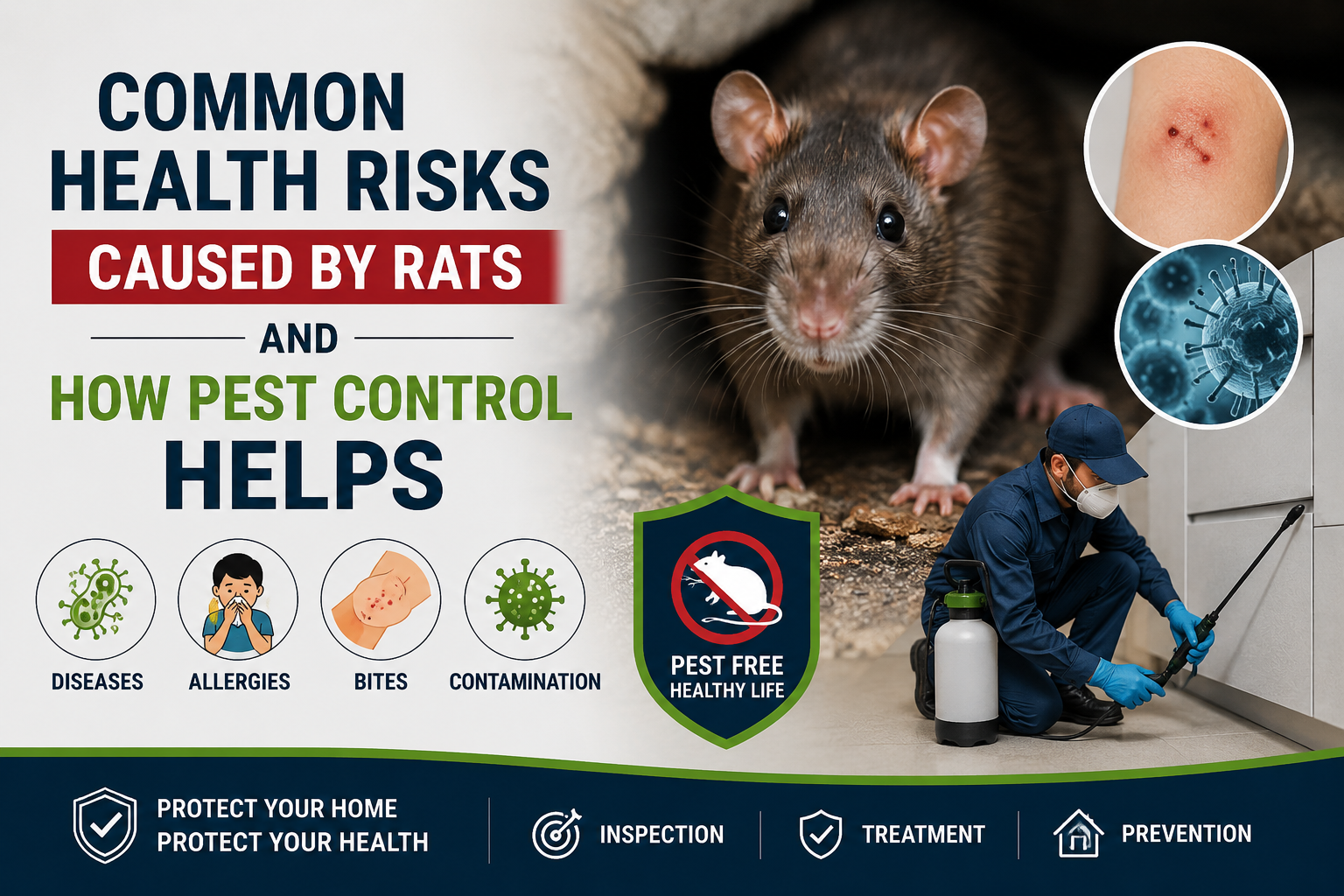
Rats are far more than a nuisance. They carry dangerous pathogens, contaminate food, and put your family at serious risk every single day they go unaddressed. Here’s what you need to know — and how to act.
Finding a rat in your home or business is alarming — and rightfully so. These small, fast-moving creatures aren’t just frightening to spot; they bring with them a host of serious health hazards that can affect every member of your household, including pets. Across densely populated cities, rat infestations are a growing concern, and ignoring them even briefly can have lasting consequences for your health.
In this article, we break down the most common health risks posed by rats, explain how infestations spread disease, and outline exactly how professional pest control services can protect your home and family.
Did you know? Rats can carry over 35 diseases that are directly or indirectly transmissible to humans — many of which are potentially life-threatening if left untreated.
Why Rats Are a Serious Public Health Threat
Rats are not just a property problem. From the moment they enter your home, they begin leaving behind a trail of contamination — through droppings, urine, saliva, and the parasites they carry on their fur. A single rat can produce up to 40 droppings per night, and just one infected rodent can contaminate hundreds of square feet of food storage area within days.
Unlike many other pests, rats are social animals. Where there’s one, there are almost certainly more. Rat populations grow quickly, and with each additional rodent, your exposure to disease-carrying waste multiplies significantly.
How rats spread disease
Rats transmit illness in several ways. Understanding each pathway is important for gauging just how serious an infestation can become:
- Direct contact — handling a live or dead rat, or being bitten or scratched
- Contaminated food and water — consuming food or drink that has come into contact with rat urine, droppings, or saliva
- Airborne particles — inhaling dust contaminated with dried rat waste (particularly dangerous in enclosed spaces)
- Secondary vectors — fleas, ticks, and mites that feed on infected rats and then bite humans
The Most Common Diseases Caused by Rats
Here are the key illnesses associated with rat infestations, each of which is a legitimate medical concern:
Leptospirosis
Spread through rat urine contaminating water or soil. Can lead to kidney damage, liver failure, and meningitis. Often misdiagnosed as flu in early stages.
Hantavirus
Transmitted by inhaling dried particles of rat droppings or urine. Hantavirus Pulmonary Syndrome has a fatality rate of up to 38% in reported cases.
Salmonellosis
Caused when rats contaminate food preparation surfaces or food stores. Results in severe gastrointestinal illness, especially dangerous for children and elderly individuals.
Rat-Bite Fever
Transmitted through bites, scratches, or contact with infected rat feces. Symptoms include fever, joint pain, and rash. Can be fatal if untreated.
Plague
Historically devastating, plague is still a concern today. Rats carry fleas infected with Yersinia pestis, which can be transmitted to humans via flea bites.
Typhus
Murine typhus is spread by rat fleas. Causes prolonged fever, headaches, and rash. Endemic in parts of Asia and remains a risk in urban areas.
Beyond Illness: Other Health Hazards Rats Create
Disease transmission is the most alarming risk, but rats also create health problems in less obvious ways that are easy to overlook until the damage is done.
Allergies and respiratory issues
Rat dander, urine proteins, and shed skin particles become airborne and can trigger or worsen allergies and asthma — particularly in children and those with pre-existing respiratory conditions. Living in a space with a hidden rat infestation can cause ongoing, unexplained allergy flare-ups.
Food contamination and poisoning
Rats are opportunistic feeders. They regularly gnaw through packaging, contaminate stored grains, fruits, and vegetables, and leave behind bacteria-laden waste on kitchen counters and inside cupboards. Food contaminated in this way may look normal but carry pathogenic bacteria that cause serious foodborne illness.
Structural hazards linked to rat activity
Rats gnaw constantly — on wood, plastic, rubber, and even electrical wiring. Chewed wiring is one of the leading hidden causes of house fires. While this isn’t a direct health risk in the traditional sense, it’s a life-safety concern that demands the same urgency as any disease threat.
“A rat infestation is never just a property problem — it is a public health emergency that escalates with every day of inaction.”
Why DIY Rat Control Often Falls Short
Many homeowners try to manage rat problems themselves using traps or store-bought poisons. While these can occasionally reduce visible rat activity, they rarely eliminate the root cause of an infestation. Here’s why DIY approaches often fail:
- Traps and baits address individual rats, not the colony or entry points
- Rats are neophobic — they actively avoid new objects in their environment, making trap placement difficult
- Without proper sanitation and exclusion, new rats move in after old ones are removed
- Handling rat carcasses or droppings without protective gear exposes you to the very pathogens you’re trying to avoid
- Improper use of rodenticides can harm children, pets, and beneficial wildlife
Effective rat control requires a whole-home strategy — inspection, exclusion, treatment, and follow-up — which is exactly what professional rat pest control services are designed to deliver.
How Professional Pest Control Eliminates the Health Risks
A licensed pest control team addresses rat infestations in a structured, systematic way that goes well beyond placing a few traps. Here’s the process a professional service follows:
1.Thorough Inspection
Technicians inspect your entire property — including attics, basements, utility runs, and exterior walls — to identify active colonies, nesting sites, food sources, and all entry points.
2.Targeted Treatment
Using safe, approved rodenticides and mechanical trapping methods placed strategically based on rat behavior patterns, not guesswork.
3.Exclusion & Sealing
All identified entry points — gaps in walls, pipe penetrations, roof joins, drain covers — are sealed with rodent-proof materials to prevent re-entry.
4.Sanitation Guidance
Experts advise on cleaning contaminated areas safely, reducing attractants like exposed food waste, and maintaining conditions that deter future infestations.
5.Follow-up & Prevention
Scheduled follow-up visits confirm the infestation is resolved and catch any new activity early, before it becomes a serious problem again.
At Prime Pest Control, every rat control job begins with a detailed on-site inspection — because no two infestations are identical. Our trained technicians use eco-friendly, government-approved products to protect your family’s health while fully eliminating the infestation at its source.
Protecting Your Family: Warning Signs to Watch For
Early detection makes all the difference. If you notice any of the following signs, contact a professional immediately rather than waiting to see if the problem resolves itself:
- Dark, pellet-shaped droppings near food sources, along walls, or in cupboards
- Gnaw marks on wood, plastic packaging, or wiring
- Scratching, scurrying, or squeaking sounds — especially at night
- Greasy rub marks along walls and skirting boards (caused by rats’ oily fur)
- Burrows or nesting material (shredded paper, fabric, or insulation) in hidden corners
- A strong, musky, ammonia-like odour in enclosed areas
- Pet behaviour changes — dogs and cats becoming alert or agitated near walls
Spotted the signs? Don’t wait.
Rat infestations worsen rapidly. Our team is ready for a same-day inspection and safe, effective treatment — protecting your family from the health risks rats carry.